


The discovery of 50,000-year-old stone tools in the Negev desert marks the entrance of our forefathers from Africa, as well as the birth of a new technology that would spread alongside humans as they conquered the globe.
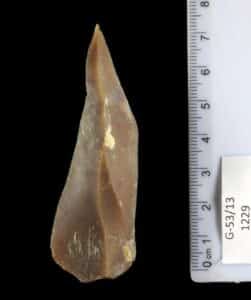
Hominins have been making stone tools for hundreds of thousands of years: rough scrapers, hefty triangular spearheads, and other rather complex but unchanging artefacts. Around 50,000 years ago, the utensils changed dramatically. Sharper and lighter spear-points appeared, along with thin and lethal blades. This new technology had swept over the globe in a matter of millennia, or a heartbeat in ancient words.
In Eurasia, archaeologists refer to this period as the transition between the Middle and Upper Paleolithic. Experts have long questioned if the migration of modern Homo sapiens from Africa, which occurred around the same period, may be connected to this technological breakthrough.
Archaeologists have discovered the earliest occurrence of the so-called Initial Upper Paleolithic tool culture in Israel’s Negev desert. Indeed, they attribute its development to our ancestors’ final big migration out of Africa.
The researchers claim in a study published Monday in PNAS that they correctly dated archaeological strata containing cutting-edge stone tools at the site of Boker Tachtit to 50,000-49,000 years ago.
Prof. Elisabetta Boaretto of the Weizmann Institute of Science in Rehovot, the study’s principal researcher, says that they utilised radiocarbon dating of charcoal remnants as well as optically stimulated luminescence, a technique that reveals when sediments were last exposed to sunlight.
Boker Tachtit is an open-air site along the banks of the Zin seasonal river that was most likely utilised by prehistoric hominins as a hunting base camp. Archeologists initially looked at the site in the 1980s. However, because dating techniques were not as sophisticated at the time, archaeologists performed fresh digs in 2013-2015 to estimate the age of the bones with greater precision, according to Boaretto.
where have the earliest human fossils been found in africa
Having to compete with Neanderthals
No human remains were discovered at Boker Tachtit, which is common at ancient sites and one of the reasons why researchers have difficulties determining which group of hominins used certain tools. (The tools are still there, but the human bodies have decayed or been eaten by hyenas.)
However, in the instance of Boker Tachtit, the site’s new date, along with the nature of the tools, points to a definite relationship to Homo sapiens, according to Boaretto.
That’s because there are many additional prehistoric sites nearby that date from approximately 50,000 years ago, and the hominins that lived there employed more archaic Middle Paleolithic tool technology. According to Omry Barzilai, head of the Israel Antiquities Authority’s archaeological research department, “at least some of the occupants of these other sites have been convincingly recognised as Neanderthals.”
According to Boaretto and Barzilai, the abrupt arrival of more advanced Initial Upper Paleolithic artefacts in the Negev shows that this was a unique technology brought in by newly arriving Homo sapiens, who coexisted for a while with the older civilization of the Neanderthals in the Levant.
The Neanderthals are thought to have arrived in what is now Israel from the north around 70,000 years ago and vanished around 50,000 years ago.
“We observe a non-local population arriving in the Negev at a period when Neanderthals are still present,” Barzilai told Haaretz. “We would witness a delayed shift if it was something produced locally by the Neanderthals. Instead, we have evidence of two civilizations coexisting at the same time, the ancient native one and the new one.”
Furthermore, compared to the glacial rate of prior technical transition, the “new culture” of more complex stone tools emerged relatively quickly, according to Boaretto. She points out that a later era of occupancy at Boker Tachtit, dating from 47,000 to 43,000 years ago, already shows a more evolved variant of the early Upper Paleolithic stone tool civilization.
She explains, “This offers us invaluable information on the speed and tempo of technical progress, which was certainly quite quick.”
Migrations of early humans
It’s still unknown where Homo sapiens got the idea for their new stone tool technology. The Arabian Peninsula and the Nile Valley are the nearest and most apparent areas, yet neither has provided sites indicating unambiguous predecessors of the Initial Upper Paleolithic toolkit, according to Barzilai.
Researchers argue that regardless of where this new toolset comes from, it clearly represents a significant stride forward in human development.
300,000 years ago, archaic Homo sapiens roamed across Africa, making short ventures outside the continent. Sapiens bones going back over 200,000 years have been discovered in an Israeli cave on Mount Carmel, and there is some evidence – though it is highly debated – that these early human migrations reached southern Europe.
According to Professor Jean-Jacques Hublin, head of the Department of Human Evolution at the Max Planck Institute for Evolutionary Anthropology in Leipzig, Germany, the first humans to leave Africa did not appear to make much of a splash in Eurasia. He adds that they stayed close to habitats comparable to those found in Africa, whereas Neanderthals remained the dominant hominid group throughout western and central Eurasia, including the Levant.
He adds that genetic testing has revealed that modern humans have no genetic ties to the early sapiens migrants. Instead, we are all descended from the last big migration out of Africa, which began about 60,000 years ago and whose first steps into Eurasia have now been documented in Boaretto and colleagues’ study.
Now let’s go on to something entirely different.
Something was definitely different about the individuals that left Africa this time. Advanced tools similar to those found at Boker Tachtit had spread as far as Mongolia and Eastern Europe within a few millennia, according to Hublin, who has previously excavated one such site in Bulgaria. Following that, successive waves of migration would settle the entire world.
“Something happened with these groups, something that allowed them to spread everywhere,” Hublin says. “Something happened with these groups, something that changed their way of interacting with the environment, exploiting resources, and competing with other groups like the Neanderthals, something that allowed them to spread everywhere.” “So, what was this innovation?” says the narrator.
One theory is that their hunting weapons provided them with an advantage. According to Barzilai, the spearpoints of the Upper Paleolithic stone culture are sharper and lighter than their archaic forefathers. These could be used for javelins, but they weren’t quite dainty enough to be mounted on arrows, which were already in use in Africa but would only arrive in Eurasia later.
Projectiles like spears and javelins, even before arrows, gave human hunters greater range while staying at a safe distance, as well as the ability to fall smaller, faster prey, according to Barzilai.
“The spear becomes lighter and more elegant, transforming from a stabbing weapon to a projectile, giving Homo sapiens a significant advantage over other Eurasian hominins,” he says.
Hublin points out, however, that technology was most likely only one part of the storey. Archaeologists have discovered large amounts of symbolic, seemingly non-utilitarian objects, such as perforated shells used for ornamentation, at Early Upper Paleolithic sites in Eurasia, and even earlier ones in Africa, he says. They have also found inexplicable collections of seemingly non-utile crystals dating half a million to 105,000 years ago. “This signals a change in the social complexity of these groups, in terms of individual status and identification of the group vis-a-vis other groups,” Hublin says. “It’s something Eurasia has never had before.”
Know who you are
To be clear, there are signs that early hominins, including Neanderthals and even possibly Homo erectus, occasionally engaged in symbolic behavior, making some form of art or collecting pretty things.
But those instances are rare, and symbolism is only widely used outside of Africa among the sapiens of the Initial Upper Paleolithic, according to Hublin.
“Humans are good at networking and forming large coalitions of people, and we have evidence that people knew they belonged to a specific group in the Initial Upper Paleolithic,” he says. “It’s not the tools you make that make you belong to a group; it’s the things you believe in, the shared stories about gods or mythical animals that will fix your identity.”
To put it another way, the rise in symbolic behavior resulted in the formation of shared identities and larger societies. As a result, individuals had a larger support network, allowing humans to expand beyond their native ecosystem and adapt their technologies to almost any environment they came across.
Hublin concludes, “The Middle Paleolithic culture was quite static; it didn’t change for a long time.” “But starting with the Initial Upper Paleolithic, new technologies are constantly supplanting each other, and we enter into a cycle of innovation and change that is very fast, and will never stop.”
Join Us
Youtube
FaceBook
Instragram
Tiktok


